
Turning a 6% Reimbursement Gain Into $6M in Revenue
The problem
Bioventus, a leading orthobiologics company, was processing device orders on paper — literally filling out forms, faxing them to head office, and waiting to find out if patient eligibility cleared. The error rate on first-time submissions was high enough to materially drag reimbursement approval rates, and every percentage point of reimbursement represented roughly $1 million in annual revenue.
The approach
The core challenge was multi-stakeholder: sales reps in the field needed speed, physicians needed accuracy, and administrative teams needed clean data for reimbursement processing. The paper process optimized for none of them.
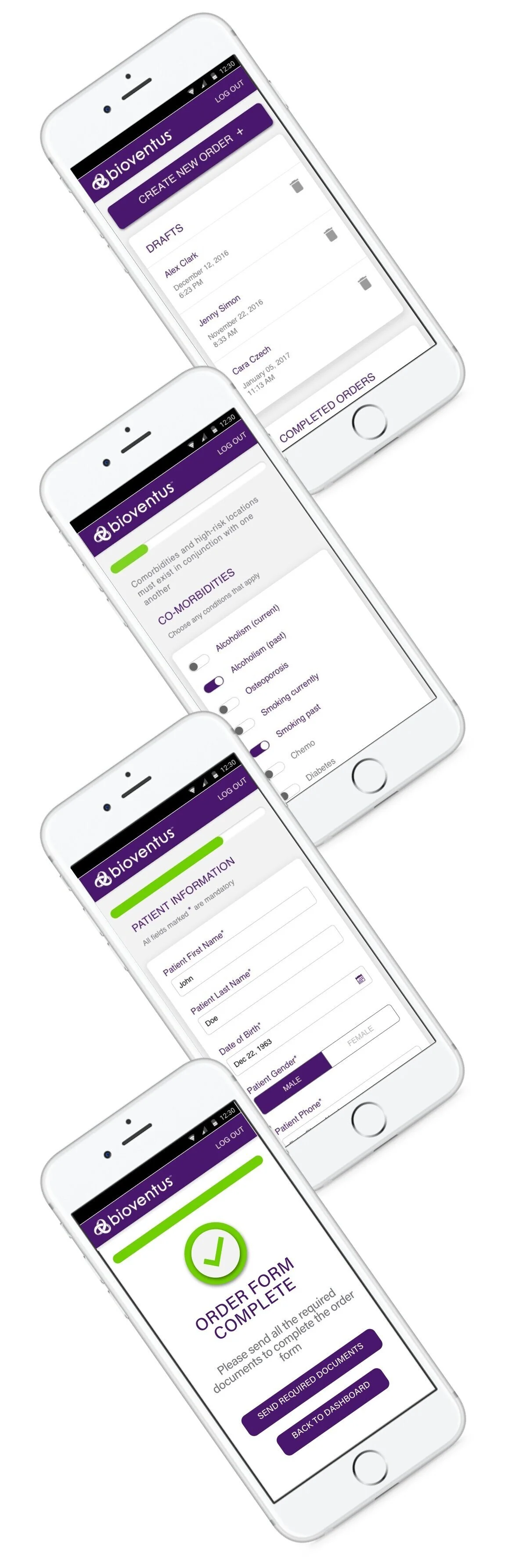
I mapped the end-to-end order workflow to identify where errors entered the system. Most weren't carelessness — they were structural: ambiguous form fields, no real-time eligibility validation, and no mechanism for the system to flag incomplete submissions before they were sent. The digital tool I designed addressed each failure point: structured inputs that reduced ambiguity, real-time patient eligibility checks that caught issues before submission, and a completion-state model that prevented partially-filled orders from entering the processing pipeline.
The trickiest design decision was balancing thoroughness with speed. Sales reps need to complete orders between appointments — if the tool felt slower than paper, they'd route around it. I designed the flow so that the validation logic ran in the background and surfaced issues inline, rather than gating submission behind a long validation step.
Impact
Reimbursement approval rates increased 6% nationwide — representing approximately $6 million in annual revenue. Clean first-time submission rates increased significantly, and the coordination friction between sales reps, physicians, and patients decreased measurably.